



















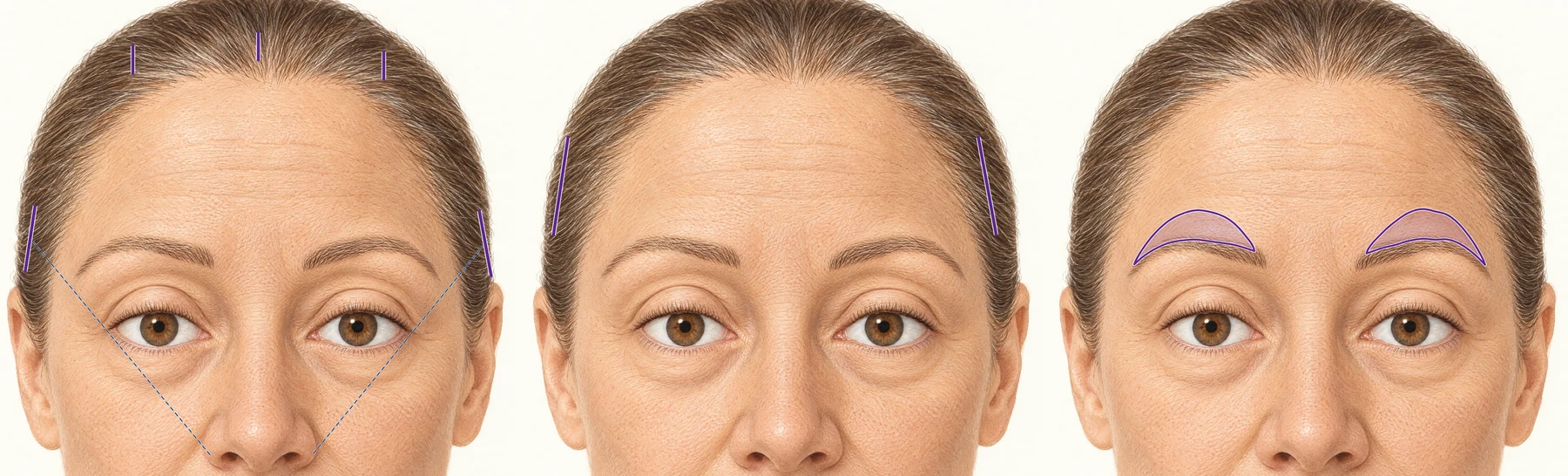
What it treats
- Excess upper eyelid skin is often partly caused by low brows; blepharoplasty alone does not correct this and can make the brow sag further (PMID 6824482).
- Across published studies, brow height fell about 1.5 mm after upper eyelid surgery; simple blepharoplasty lowered the brow about 0.7 mm, and skin removal itself did not change brow height (PMID 36890345).
- In another series, brows fell about 1.7 mm after blepharoplasty alone (PMID 25853507).
- After upper blepharoplasty, brow position was unchanged in about 2 in 3 patients and lower in about 1 in 3, including about 6 in 10 men and 3 in 10 women (PMID 27308242).
- Functional brow surgery is reserved for severe asymmetry or visual field loss; the usual options are browpexy through a blepharoplasty, direct brow lift and midforehead lift (PMID 35738352).
Brow ptosis assessment
- McKinney 1991: normal distance from midpupil to the top of the brow about 2.5 cm; less than that suggests a forehead lift may help (PMID 2035363).
- The male brow sits along the orbital rim with a flat contour; brow ptosis was uncommon, about 1 in 14 men; mean brow position did not change with age; deep-set eyes had lower brows (PMID 16052142).
- With age the brow moves up and women's brow shape comes to resemble men's; lifting can then look surprised or older (PMID 30819648).
- Missed points in the mid-temporal part of the visual field predicted selection for combined eyelid and brow surgery, and combined repair had lower odds of revision (PMID 42697227).
- Patients with heavy brows, marked ptosis, medial more than lateral ptosis, or prior facial palsy may be poor candidates for internal browpexy (PMID 31261340).
How it is done
Internal (transblepharoplasty) browpexy
- Sokol and Sokol reported transblepharoplasty brow suspension in 1982 (PMID 7079400).
- Zarem technique: the upper cut edge of the orbicularis muscle is sutured to the arcus marginalis at the orbital rim with 2 to 4 absorbable 4-0 sutures (PMID 19336182), first reported in a large series of patients (PMID 9326790).
- Quantitated internal suture browpexy places the suture at measured points for consistent, symmetric results (PMID 25853507).
- Adding partial orbicularis resection ("tuck and rise") raised the brow tail about 2.4 mm (PMID 27429226).
- Periosteal pexy, orbicularis fixed to the arcus marginalis, lateral orbicularis removal and retaining ligament release raised the brow tail about 3.4 mm at 1 and 3 months (PMID 37592144).
External browpexy
- Transcutaneous variant through a small incision at the brow; one patient noticed a subtle scar (PMID 22410656).
Direct brow lift
- An ellipse of skin and fat is removed within or just above the brow hairs; it can be limited to the lateral brow, or placed in the midforehead or eyelid crease (PMID 35710156).
- Scar-minimizing methods include a beveled incision that spares brow follicles, limited undermining, suspension to the periosteum, and layered closure (PMID 42355613).
- A deep plane direct lift uses orbicularis transection and suspension (PMID 40064642).
- Repositioning the retro-orbicularis oculi fat (ROOF) during a direct lift more than doubled the brow-to-corneal-reflex distance (PMID 41738837).
- Facial palsy modification: W-plasty style incision, counter-beveled edges, skin removed in the subcutaneous plane with minimal fat removal, browpexy to the periosteum (PMID 32852375).
Midforehead lift
- Skin removed through a forehead crease incision (PMID 2035363); one series used it for all brow ptosis, mostly in women (PMID 2914087).
- Surgeons and laypersons rated the results highly (PMID 21931089).
Results and evidence
Browpexy
- At 4 to 5 months, internal browpexy raised the outer brow about 2 mm and external browpexy about 3 mm; the difference was not significant (PMID 28267396).
- At 24 months, both internal and external browpexy held a lift of about 2 to 3 mm, against about half a millimeter for blepharoplasty alone (PMID 32049161).
- At 3 months, external browpexy lifted more than internal; skin excision alone lowered the whole brow (PMID 36847688).
- In a large series of internal browpexies, the outer brow rose about 2.5 mm on average (PMID 31261340).
- Quantitated suture browpexy prevented descent and raised the outer brow about 1 mm; an Endotine forehead lift gave about 4 mm (PMID 25853507).
- Browpexy added more fullness to the outer brow and eyelid area than blepharoplasty alone (PMID 34166117).
- Internal browpexy raised the outer brow about 2 mm at 6 months; a temporal brow lift did not change it (PMID 28975711).
- Nearly all transpalpebral browpexies reached optimal elevation, with few revisions (PMID 29098368).
Durability
- Over up to 5 years, brows fell after transpalpebral browpexy and stayed up after endoscopic forehead lift (PMID 23190834).
- At 1 year after blepharoplasty, direct (excisional) browpexy lost about 1 to 2 mm of lift and transpalpebral lift lost about 0.7 mm at the pupil (PMID 36669433).
Direct brow lift
- In men having blepharoplasty, nearly all had significant elevation at 12 months, with a visible scar in a few (PMID 27274124).
- In facial palsy, brow height was rated excellent in about 7 in 10 and good in about 1 in 7; there was no forehead numbness or brow hair loss (PMID 32852375).
- Deep plane direct lift gave symmetric brows in nearly all patients (PMID 40064642).
- In one surgeon's practice, women mostly had endoscopic lifts and fewer had direct lifts, while men mostly had direct lifts and fewer had endoscopic lifts (PMID 40016580).
Risks and complications
- A review of the brow lift literature found direct brow lifts had the highest numbness rate of all brow lift types, about 5 in 100 (PMID 30534495).
- Forehead numbness after brow lift has been reported as high as about 4 in 10; the supraorbital notch or foramen, where the forehead nerve exits, lay about 18 to 32 mm from the midline and was a foramen in about 1 in 3 orbits, so nerve position varies (PMID 23299811).
- Direct lift: a visible scar, granulomas from braided absorbable sutures, and the brow dropping again; transblepharoplasty lift: less lift than desired and skin dimpling from sutures (PMID 17182403).
- In a large internal browpexy series, a few early infections all resolved, a few patients later had a direct brow lift, and a few later had repair of unrecognized eyelid ptosis (PMID 31261340).
- Brow lift with blepharoplasty had a major complication rate under 1%, the same as blepharoplasty alone; hematoma was the most common (PMID 29369102).
Recovery
- Sensory changes after a deep plane direct lift were temporary and resolved in 3 to 5 months (PMID 40064642).
- Patches of reduced forehead sensation after a direct lift normally recover within a few months (PMID 17182403).
- Direct lift scars: postoperative laser and perioperative neuromodulator improved appearance; evidence for silicone gel was inconclusive (PMID 42355613).
- External browpexy: all patients were pleased at about 6 months (PMID 22410656).
- Skin excision below the brow (subbrow blepharoplasty) as an alternative: scarring was rare at 6 months and there was no sensory loss (PMID 41240177).
Combined procedures
- McKinney 1991 lists a previous facelift among three indications for forehead lift and reserves the direct brow lift for minimal ptosis, asymmetry, or patients who want a minimal procedure (PMID 2035363).
- Brennan 1982 analyzed midforehead glabellaplasty, browpexy and facelift together as parts of full-face rejuvenation (PMID 7138368).
- A PubMed search on 2026-09-30 for browpexy or direct brow lift with facelift terms in title or abstract found no combined-procedure outcome series; the only relevant papers are the criteria and technique papers above (PMID 2035363, PMID 7138368).
- Combined-procedure safety data come from blepharoplasty: adding a brow lift did not raise major complications (PMID 29369102).
Current questions
- Internal against external browpexy: equal lift in two studies (PMID 28267396, PMID 32049161); more lift with external in one (PMID 36847688).
- Durability: measured descent at 1 year (PMID 36669433) and up to 5 years (PMID 23190834) after transpalpebral techniques.
- Volume: browpexy may add fullness to the lateral brow and eyelid rather than height alone (PMID 34166117).
- Direct lift refinements 2025-2026: scar-minimizing closure (PMID 42355613), ROOF repositioning (PMID 41738837), deep plane lift (PMID 40064642).
- Visual field criteria for adding a brow procedure to eyelid surgery (PMID 42697227).
- Sex-based technique choice (PMID 40016580).
- Search string used:
(browpexy[tiab] OR direct brow lift[tiab] OR direct browlift[tiab] OR direct browplasty[tiab] OR direct brow-lift[tiab]) AND (facelift[tiab] OR face lift[tiab] OR rhytidectomy[tiab] OR face-lift[tiab])(https://pubmed.ncbi.nlm.nih.gov/).
Terms
- Brow ptosis: a brow lower than its normal position, with cosmetic or visual effects (PMID 35738352).
- Dermatochalasis: excess upper eyelid skin (PMID 28975711).
- Internal browpexy: suturing the brow tissue to the bone or rim through the eyelid incision (PMID 9326790).
- External browpexy: the same suspension placed through a small incision at the brow (PMID 22410656).
- Arcus marginalis: the thickened tissue along the orbital rim used as an anchor (PMID 19336182).
- Orbicularis oculi: the ring muscle around the eye; its upper edge is sutured in browpexy (PMID 19336182).
- ROOF: retro-orbicularis oculi fat, the fat pad under the brow (PMID 41738837).
- Direct brow lift: removal of skin just above the brow hairs (PMID 35710156).
- Midforehead lift: skin removal through a forehead crease (PMID 2914087).
- Supraorbital notch or foramen: exit point of the forehead sensory nerve on the orbital rim (PMID 23299811).