



















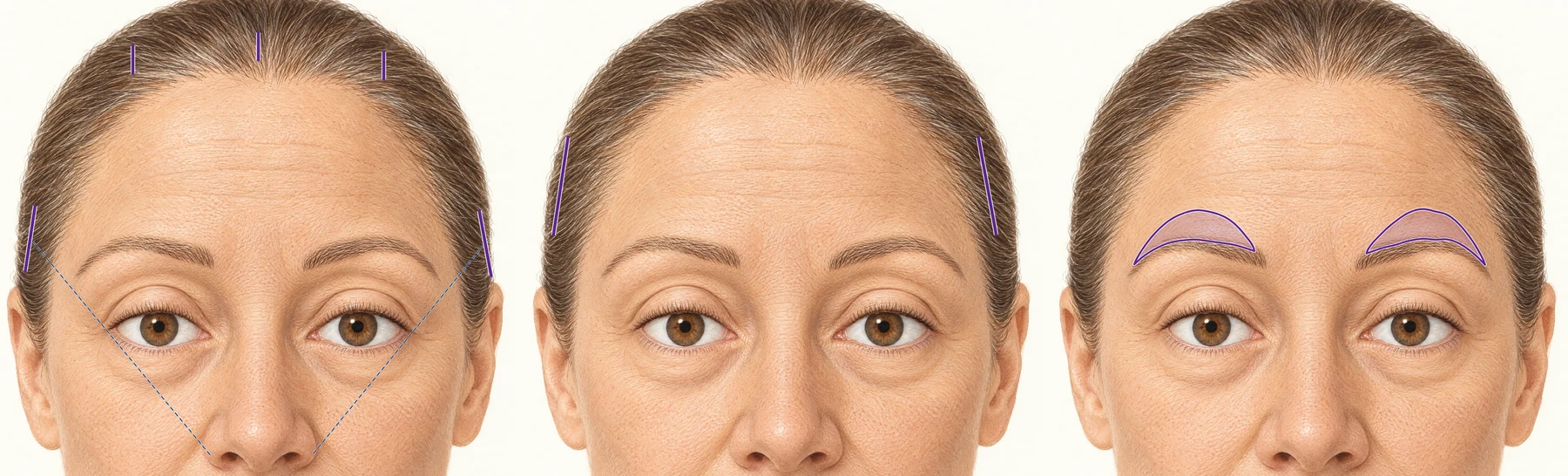
Why they are combined
- The brow, the upper eyelid skin and the lower eyelid and tear-trough contour are planned together in one surgical overview (PMID 20595828). Brow lift technique is covered in browpexy-and-direct-brow-lift.md, temporal-and-lateral-brow-lift.md and endoscopic-brow-lift.md.
- About 1 in 7 people considering upper blepharoplasty had undiagnosed ptosis, most of it mild, and uneven eyebrows were a strong sign of it. An uneven brow can therefore mean a low eyelid rather than, or as well as, a low brow (PMID 37694225). Ptosis repair is covered in blepharoptosis-repair.md.
- Surgeons who do many upper blepharoplasties add a brow lift, fat grafting and ptosis repair more often than surgeons who do few (PMID 33346340).
- In one series, about 1 in 3 upper blepharoplasties included a brow lift and about 1 in 5 included ptosis correction (PMID 38315110).
- Blepharoplasty is the most common procedure added to a facelift, and facelift patients in a national registry averaged more than 2 procedures and about 4 hours of surgery (PMID 32459769).
Sequencing
- A surgical overview presents an endoscopic or lateral brow lift, upper lid blepharoplasty with supratarsal fixation, and lower lid blepharoplasty with tear-trough correction as parts of one plan for the upper face (PMID 20595828). Tear-trough and lid-cheek junction technique is covered in tear-trough-and-lid-cheek-junction.md.
- In a small group of patients, lifting several facial planes in one setting (facelift, forehead contouring with brow lift, cheek implants, nose and jaw surgery) caused no vascular complications; the complications seen were the ones already known for each operation (PMID 31098694).
- After facelifts under local anesthesia, blood clots were less common with surgeons who do many facelifts and have shorter operating times; limiting add-on procedures was proposed as a way to shorten surgery (PMID 23708241).
- Complication risk rises with operating time: about 20% higher odds for each added hour, and the risk keeps climbing past 3 hours (PMID 24696297). A review of facial plastic outpatient surgery linked longer procedures to more complications as well (PMID 30476941).
Brow position after upper blepharoplasty
- Across published studies the brow drops slightly after upper eyelid surgery, about 1.5 mm on average. Simple blepharoplasty lowers it about 0.7 mm, double-eyelid surgery about 2.5 mm and ptosis correction about 2 mm; removing skin does not change brow height by itself (PMID 36890345).
- In an early series of patients with low brows who declined a browpexy, most eyes showed no significant brow change after blepharoplasty alone, a few had mild to moderate descent, and all patients were pleased with the result (PMID 1390430).
- In East Asian patients, the distance from the upper lid margin to the brow shortened after both blepharoplasty and levator advancement, more after levator advancement (PMID 22421841).
- Angle measurements from photographs showed the brow moving down after upper lid blepharoplasty, most at the outer part and on both sides (PMID 22571187).
- A small study found no significant change in brow height at the inner, middle or outer brow once fat removal, eye dominance and change in lid height were accounted for (PMID 26505314).
- Brow height fell after blepharoplasty alone and rose slightly when an internal browpexy was added (PMID 39150758).
- A lateral pretrichial brow lift combined with upper blepharoplasty lifted the outer brow clearly, and every patient was satisfied or highly satisfied (PMID 40820029).
Results and evidence
- Major complications were rare, under 1%, and did not differ between blepharoplasty with brow lift, blepharoplasty alone and brow lift alone. Hematoma, a collection of blood under the skin, was the most common problem in all three groups (PMID 29369102).
- Revisions were needed after about 4 in 100 upper blepharoplasties alone and about 9 in 100 when ptosis correction, and in some cases a brow lift, was added; the reasons were overcorrection, leftover skin and asymmetry (PMID 38315110).
- After facelifts, about 1 in 20 patients had an adverse event, most often hematoma or infection. Combined procedures, longer surgery, general anesthesia and office-based surgery were each linked to higher odds of one (PMID 32459769).
Risks and complications
- Blood clots in the legs or lungs (venous thromboembolism) are rare after cosmetic surgery, under 1 in 1,000 overall. Combined procedures carried more than double the clot risk of a single procedure, and face-only procedures had among the lowest clot rates (PMID 28207041).
- After facelifts under local anesthesia, clots occurred about once in every 6,000 surgeries (PMID 23708241).
- A national review of deaths after outpatient cosmetic surgery at accredited facilities found about 4 in 10 were caused by clots, and clot-risk assessment was incorrect or missing in more than half of the cases reviewed (PMID 29649062).
- Across outpatient plastic surgery, about 6 in 100 patients had an adverse event, most often a need for antibiotics, a wound edge opening, or fluid needing drainage. Rates did not differ significantly between surgery centers and office-based facilities (PMID 36877624).
- Among patients having five common aesthetic operations, including blepharoplasty, hematoma was the most common problem at about 1 in 140; deep infection and clots were each rarer. Combining aesthetic procedures was one factor linked to more unplanned healthcare use (PMID 36728533).
- Breast surgery data show combining procedures raising complication risk (PMID 28333172), a pattern the eyelid-and-brow data did not reproduce (PMID 29369102).
- Lower blepharoplasty and midface lifting share overlapping anatomy, and their complications are reviewed together; careful evaluation before surgery helps choose the right combination of techniques (PMID 25440742). Midface and lid-cheek junction technique is covered in tear-trough-and-lid-cheek-junction.md.
- In a California outpatient database, the 12-month clot rate for face procedures was about 3 in 1,000, and some procedure combinations, not blepharoplasty pairings specifically, carried more than the added risk of each (PMID 25415104).
Recovery
No study separately reports recovery time for blepharoplasty combined with a brow lift or facelift against blepharoplasty alone. The recovery-related data concern clot risk: local anesthesia and shorter operating time go with fewer clots after facelift (PMID 23708241), and combined procedures carry a higher clot risk than a single procedure (PMID 28207041).
Current questions
- Whether combining brow lift with blepharoplasty adds risk: the largest eyelid-specific review found no added major-complication risk (PMID 29369102), while broader data show combined procedures generally carry more clots and unplanned care than single ones (PMID 28207041, PMID 36728533).
- Whether upper blepharoplasty alone lowers the brow: pooled studies found a small drop (PMID 36890345); some photograph studies found a measurable descent (PMID 22421841, PMID 22571187) and one found none once other factors were controlled (PMID 26505314).
- Whether to add an internal browpexy routinely at blepharoplasty: one series reports it limits the brow drop (PMID 39150758); the approach is detailed in browpexy-and-direct-brow-lift.md.
- How long surgery can run before too many procedures are combined: complication odds rise after about 3 hours (PMID 24696297), and a review of facial plastic surgery reached a similar link without naming one universal cutoff (PMID 30476941).
- Much of the safety data comes from the plastic surgeons' TOPS outcomes registry, which holds records contributed by American Society of Plastic Surgeons members (PMID 34529595).
Terms
- Brow ptosis: a lowered eyebrow position, which can be mistaken for or coexist with upper eyelid dermatochalasis (PMID 37694225).
- Dermatochalasis: excess, lax eyelid skin, covered in upper-blepharoplasty.md.
- Internal browpexy: a suture technique that fixes brow position through an upper blepharoplasty incision, detailed in browpexy-and-direct-brow-lift.md.
- MRD1: distance from the corneal light reflex to the upper lid margin, used to measure lid and indirectly brow position (PMID 22421841).
- Rhytidectomy: the surgical term for a facelift (PMID 32459769).
- CosmetAssure: a cosmetic surgery complication insurance program whose claims data are used to study major complication rates across practices (PMID 29369102).
- TOPS: Tracking Operations and Outcomes for Plastic Surgeons, an American Society of Plastic Surgeons outcomes registry (PMID 34529595).
- Venous thromboembolism (VTE): a blood clot, typically in the leg (deep vein thrombosis) or lung (pulmonary embolism), tracked as a major complication of combined aesthetic surgery (PMID 28207041).
- American Society of Anesthesiologists (ASA) class: a preoperative health classification used in these registries to compare patient risk across studies (PMID 32459769).