


















What it treats
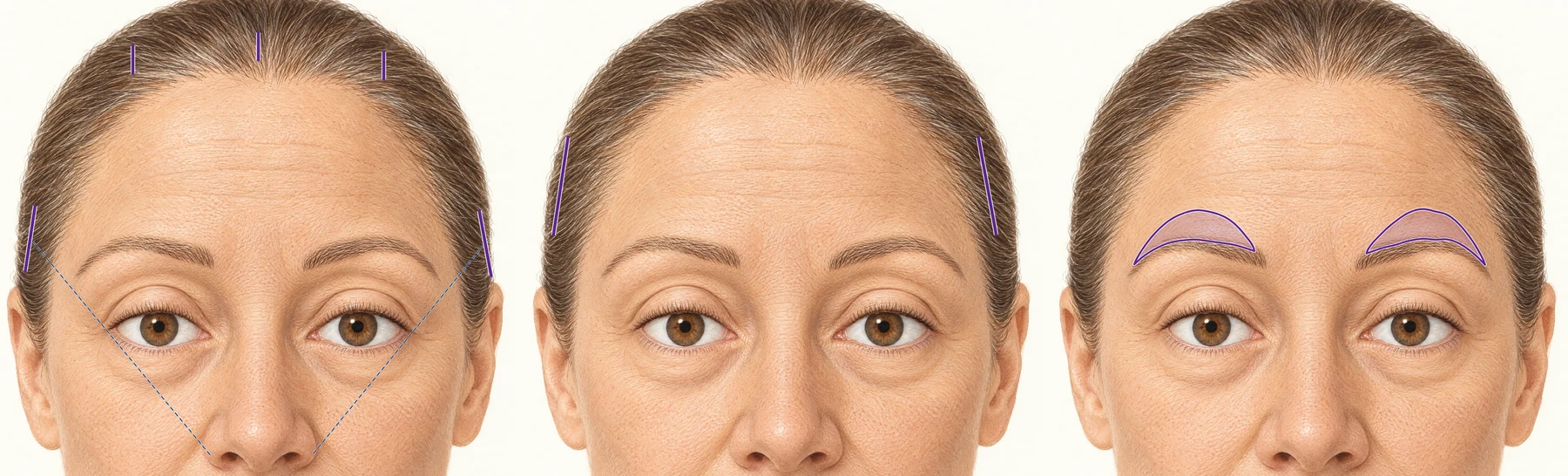
- The outer brow usually drops earlier than the inner brow; beyond the temporal fusion line the brow lacks muscle support and the soft tissue slides down over the temple fascia (PMID 8643714).
- Brows sit slightly higher in women in their 50s than in their 20s, but the difference shows at the inner and middle brow, not the outer brow, so surgeons favor lifting the outer brow selectively (PMID 19935315).
- With age the brow moves up, the distance between the inner eye corners widens and the lid axis drops at the outer corner; women's brow shape comes to resemble men's (PMID 30819648).
- The outer third of the brow ages first and most; brow shape depends on the level of the outer brow; brow lifts often succeed at the inner brow and fail at the outer brow (PMID 19371849).
- The temple and eye region have a consistent framework of fascial planes and retaining ligaments, with nerves and vessels in fixed relation to them (PMID 10744245).
- The frontal branch of the facial nerve crosses the temple; its course and variations were described for face lifting in 1966 (PMID 5926990).
- Over the cheekbone arch the frontal branch runs deep to the SMAS and moves into the superficial temporal fascia 1.5 to 3.0 cm above the arch (PMID 20124839).
How it is done
Skin-level (subcutaneous) temporal lift
- One surgeon moved from coronal, hairline and endoscopic lifts to the lateral subcutaneous temporal lift (PMID 35710152).
- The lift can be done under local anesthesia in the office without combined procedures (PMID 21131449).
- A lateral temporal subcutaneous brow lift has been used for 20 years in a large consecutive series (PMID 42224034).
- Combined with upper blepharoplasty, the lateral brow measurement rose from 46 mm to 71 mm (PMID 40820029).
Deep temporal lift (on the deep temporal fascia)
- Multiplanar temporal approach that frees the orbital orbicularis from the rim and releases the zygomatic cutaneous ligament (PMID 8618995).
- The corrugator muscle is divided through the eyelid incision, periorbital retaining ligaments are released, dissection above the deep temporal fascia is joined to the plane on the bone, the galea is advanced with sutures and extra skin is removed (PMID 31624658).
- Multi-point suture fixation anchors the lateral brow and orbicularis to the galea (PMID 26430629).
- Fogli galeapexy: the cut galea is anchored to the temporal fascia and the scalp is closed without tension or hair removal (PMID 14534826).
- A two-level (biplanar) temple lift allows more skin removal than one-level dissection, about 48% more lift (PMID 18330618).
- Endoscopic temporal brow lift combines the endoscopic and temporal approaches (PMID 31764641).
- Temporal modified orbicularis repositioning (MORE) raised patient-reported FACE-Q scores from about 34 to about 80 at 12 months (PMID 39288448).
Gliding brow lift
- Skin of the forehead, brow and temple is freed from the muscle beneath through minimal incisions, and the new brow shape is held by a net of temporary skin stitches (PMID 31511923).
- It is done through 1 or 2 small incisions with blunt dissectors and upward traction (PMID 35710153).
- The surgical net is now used for "gliding surgery" such as the gliding brow lift, beyond its first use against hematoma (PMID 38806160).
- An extended version adds deep-plane dissection in the hair-bearing scalp joined to the skin-level dissection (PMID 41217905).
Results and evidence
- A Fogli-type temporal lift improved hooding and brow position in over 90% of patients at 5 years or more; relapse was under 10% after 5 years (PMID 25502857).
- The multi-point suture lift gave satisfactory lateral elevation in about 94% of patients (PMID 26430629).
- Galeapexy results were good to very good in most patients; a small minority were unsatisfactory (PMID 14534826).
- The lateral brow lift resolved lateral hooding in all patients; about 1 in 14 needed revision (PMID 31624658).
- Endoscopic temporal lift gave a small mean elevation of 1.8 mm at the outer corner of the eye, with complications in about 1 in 70 (PMID 31764641).
- Gliding lift repositioned the brow adequately in nearly all patients at about 17 months, and recurrence was uncommon (PMID 31511923).
- The gliding lift held a significant lift at 12 months at every measured point, largest at the outer corner of the eye (about 3 mm) and brow tail (about 3 mm) (PMID 39487802).
- A whole-brow gliding lift raised the brow 5 to 7 mm at about 10 weeks; by 8 months only the outer brow lost height, by less than 1 mm (PMID 42535924).
- An extended gliding lift raised the brow tail about 3 mm, and nearly all patients were very satisfied or satisfied (PMID 41217905).
- Evidence for the gliding lift to 2023 is mostly retrospective with subjective measures (PMID 39150844).
- An endoscope-assisted polypropylene mesh lift and the gliding lift had similar results and complications; the gliding lift lost more height between months 3 and 12 (PMID 37315493).
- In a randomized comparison at blepharoplasty, internal browpexy raised the lateral brow at 6 months by about 2 mm, while temporal brow lift did not change it (PMID 28975711).
- Temporal subcutaneous lift with orbicularis repositioning reduced crow's feet in most patients, with no change between months 3, 12 and 24 (PMID 42202561).
Risks and complications
- Temporal and lateral lifts had the highest asymmetry rate of all brow lift types, about 1.5% (PMID 30534495).
- Galeapexy caused hematomas needing evacuation in about 2% of patients, temporary hair loss in about 1.5% and temporary frontal muscle weakness in about 3%, resolved in 1 to 3 months (PMID 14534826).
- After the multi-point suture lift, relapse occurred in about 5% of patients, frontal branch weakness in 1 in 100 and limited temple hair loss in under 2% (PMID 26430629).
- The lateral brow lift caused temporary frontal branch weakness in a handful of patients, no permanent nerve injury, and delayed temple wound healing in about 3% (PMID 31624658).
- Lateral temporal subcutaneous lift mainly caused temporary temple numbness, with no permanent nerve injury, hair loss or infection (PMID 42224034).
- Temporal facelift caused one-sided frontal branch weakness in about 6% of patients, resolved in about 3 months; revision was needed in about 2% (PMID 39641911).
- Gliding lift caused subjective brow asymmetry in about 1 in 7 patients, rarely frontalis weakness or a small area of skin necrosis, and no hematoma or hair loss (PMID 42535924).
- In cadavers the gliding lift's skin stitches lay closer to the frontal branch than the periosteal stitches of a suture-suspension lift; nerve injuries reported clinically so far were temporary (PMID 41286172).
- Hematoma with the hemostatic net was rare, about 1 in 700; red suture marks affected about 1 in 8 and were gone in 2 to 3 months (PMID 41936137).
- Extended gliding lift caused minor complications in about 1 in 10 patients (PMID 41217905).
Recovery
- Subcutaneous temporal lift can be done under local anesthesia in the office (PMID 21131449).
- Nearly all patients had the lateral brow lift under sedation, about a third in the office with light oral sedation (PMID 31624658).
- Temporal facelift aftercare is taping, lymphatic massage, botulinum toxin for uneven brow movement and steroid injections for midface swelling; skin dimples resolved by month 5 (PMID 39641911).
- Temporal MORE: the authors report fast recovery and a low complication rate (PMID 39288448).
- Net suture marks resolved in 2 to 3 months without lasting pigment (PMID 41936137).
Combined procedures
- Most Fogli temporal lifts were done during a three-stage (forehead, face, neck) lift (PMID 14534826).
- Most Fogli-type temporal lifts were combined with a minimal access cranial suspension (MACS) facelift (PMID 25502857).
- Brow lift was added to most MACS facelifts in a recent series, with no major complications (PMID 40906287).
- The deep temporal lift was designed as a lateral brow, temporal and upper face lift that also benefits the outer eye corner, lower lid and cheek (PMID 8618995).
- In cadavers the frontal branch lies under a separate parotid-temporal fascia over the arch and stayed intact after a high-SMAS lift (PMID 20335873).
- Temple hairline hair follicles angle shallowly to the skin, so a beveled incision lets hair grow through the scar (PMID 17440370).
- Facelift hairline incisions cut across the hair follicles scarred better than incisions parallel to them in nearly every patient (PMID 8982181).
- In the gliding lift series, the one return to the operating room for hematoma came from the facelift done at the same time, not the brow (PMID 39487802).
- For crow's feet during facelift or temporal lift, no single method has been shown most effective (PMID 38170976).
Current questions
- Gliding lift evidence base: early studies were low-level (PMID 39150844); recent series add objective measurements (PMID 39487802, PMID 42535924).
- Gliding lift durability against mesh suspension (PMID 37315493).
- Frontal branch safety of percutaneous net stitches (PMID 41286172).
- Temporal brow lift against internal browpexy for the lateral brow at blepharoplasty (PMID 28975711).
- Orbicularis release and repositioning for crow's feet during temporal lifts (PMID 42202561, PMID 38170976).
- Practice shift: isolated temporal lifts and hairline lifts are increasing while coronal lifts decrease (PMID 37409963).
Terms
- Lateral hooding: skin overhanging the outer upper eyelid from a low lateral brow (PMID 31624658).
- Temporal fusion line: ridge on the side of the skull; lateral to it the frontalis does not hold the brow (PMID 8643714).
- Deep temporal fascia: firm layer over the temple muscle used as the dissection plane and as an anchor (PMID 31624658, PMID 18330618).
- Galeapexy: anchoring the cut galea of the temple to the temporal fascia (Fogli) (PMID 14534826).
- Frontal branch: facial nerve branch to the forehead muscle; temporary injury shows as frontal muscle weakness (PMID 14534826, PMID 20124839).
- Parotid-temporal (innominate) fascia: layer deep to the SMAS that carries the frontal branch over the zygomatic arch (PMID 20335873, PMID 20124839).
- Retaining ligaments: fibrous attachments that tether skin and soft tissue to bone in the temple and around the eye (PMID 10744245).
- Gliding brow lift: skin-level release through small incisions, with the brow held by a surgical net (PMID 31511923).
- Hemostatic (surgical) net: rows of temporary stitches through the skin that hold the lifted skin in place (PMID 38806160).
- MACS lift: minimal access cranial suspension facelift (PMID 25502857).